
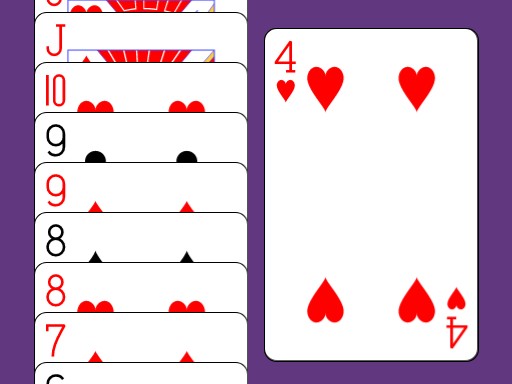
Classic Solitaire Card Puzzle
What players say
Classic Solitaire Card Puzzle strips solitaire down to its essentials: a full deck, four foundations, and no clock. The clean interface and automatic hints make it easy to learn, while the undo button encourages experimentation. It won't satisfy players looking for competitive scoring or complex variants, but for anyone who wants a quiet, strategic card game, the lack of timers and clutter is a genuine strength.
About
Sorting a Full Deck
Classic Solitaire Card Puzzle hands you a complete standard deck and a simple goal: build four foundation piles, one per suit, running from Ace up to King. The entire deck is visible from the start, so you can scan the tableau and plan several moves ahead instead of guessing. There are no hidden cards in the stock, which changes how you approach each decision—every card's location is known, and the challenge comes from sequencing, not luck.
Moving Cards with Purpose
Play begins with a tableau of columns. You move cards between columns to create descending sequences of alternating colors—for example, a red 7 onto a black 8. When a column is cleared or a sequence is complete, you can shift cards to the foundations. The game highlights obvious moves automatically, which helps new players learn the rhythm of valid plays without memorizing every rule. An undo button lets you reverse any move, so a misstep never ends the session.
No Timers, No Clutter
The interface stays out of the way. There are no time limits, no score multipliers, and no distracting animations. That design choice makes the game approachable for short breaks or long, unhurried sessions. Automatic hints point out possible moves when you stall, but they don't force a particular strategy—you can ignore them and test your own sequencing ideas. The draw pile provides extra options when the tableau runs dry, though the core loop remains about rearranging what you already see.
Building Better Habits
Experienced solitaire players tend to move Aces and Twos to the foundations early, since those cards unlock higher ranks. Uncovering face-down cards in the tableau is another priority—each revealed card adds new branching moves. The undo button doubles as a learning tool: try a sequence, reverse it, and compare outcomes. Because there's no clock, you can pause on any turn and think through the next three or four moves before committing.
Compatibility
FAQ
Comments
Sign in to comment
You must be logged in before posting a review or rating.
No comments yet. Be the first to comment!











Editorial Notes