
Number Paths 3D Labyrinth
Developer: Rune Current Labs
Published: 2026-10-01
Updated: 2026-10-01
What players say
Number Paths 3D Labyrinth takes the familiar merge mechanic and adds maze walls that block and redirect tiles. The result rewards forward planning over quick swipes, especially as layouts grow tighter and the board fills. Players who enjoy spatial puzzles and gradual difficulty will find a satisfying challenge, though those seeking fast, mindless matching may prefer a flat grid.
About
Merging Inside a 3D Maze
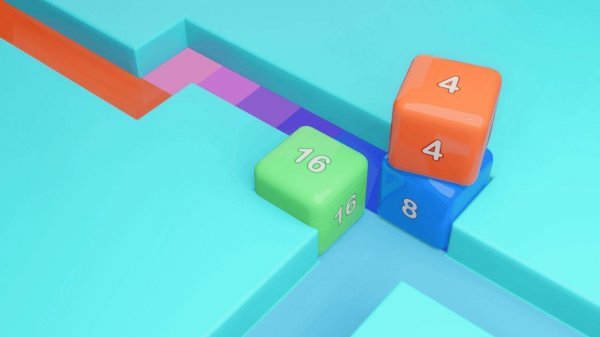
Number Paths 3D Labyrinth moves the familiar number-merge formula into a three-dimensional labyrinth. Instead of a flat grid, the board has corridors and barriers, so each swipe shifts every tile in that direction until it hits a wall or another tile. When two tiles share the same value, they combine into one tile carrying their sum. The goal is to keep merging until a 2048 tile appears, though play continues as long as moves remain possible.Walls, Corners, and Planning Ahead
The maze layout changes how tiles move. Walls block paths, and corners can trap tiles that would otherwise slide freely. Because of this, players cannot simply move tiles anywhere they like. Keeping high-value tiles near edges or in open areas helps preserve flexibility, while planning several moves ahead becomes necessary once the board fills and options shrink. Each swipe is a commitment that affects the whole board.Difficulty That Ramps Naturally
Early sessions use simple layouts with few walls, giving players room to learn basic movement and merging. Later stages introduce more complex mazes with longer corridors and tighter spaces. As more tiles appear and available room decreases, the challenge increases without overwhelming newcomers. This gradual escalation keeps the experience engaging for players who prefer a measured learning curve.Visual Clarity and Responsive Controls
The 3D perspective gives each maze a clear sense of depth, making it easy to see which paths are open. Controls respond quickly to swipes or button taps, so attention stays on strategy rather than input problems. The clean visual style avoids clutter, helping players track tile positions and anticipate upcoming moves.Compatibility
✅ Works on PC & Mobile | Recommended: Chrome / Safari / Edge
FAQ
What happens when two tiles with the same number touch in Number Paths 3D Labyrinth?
They combine into a single tile carrying their sum. This is the core merging rule, and it applies whenever matching values collide after a swipe. Chaining merges in one move is possible if the resulting tile meets another match, which is key to reaching higher numbers efficiently.
Does Number Paths 3D Labyrinth end when I create a 2048 tile?
No. The 2048 tile is the main objective, but the game continues as long as moves are possible. You can keep merging beyond 2048, though the board may become harder to manage as space fills up. Deciding when to stop is part of the challenge.
How do walls and corners affect tile movement in this 3D maze?
Walls stop sliding tiles, and corners can trap them. Because every swipe moves all tiles until they hit an obstacle or another tile, walls and corners change where tiles end up. This makes positioning more important than in a flat merge game, since a single swipe can reshape the whole board.
Is Number Paths 3D Labyrinth suitable for players new to number-merge puzzles?
Yes. Early layouts use few walls and simple paths, so newcomers can learn basic sliding and merging before facing tighter mazes. The difficulty increases gradually as more tiles appear and space decreases. Players who prefer a gentle start will find the early stages approachable.
What controls does Number Paths 3D Labyrinth use?
The game responds to swipes or button taps. Both input methods shift all tiles in the chosen direction until they stop against a wall or another tile. Controls are designed to be responsive so that planning, not input precision, determines success.
What makes Number Paths 3D Labyrinth different from a standard 2048 game?
The board is a three-dimensional labyrinth with corridors and barriers rather than a flat grid. Walls and corners restrict movement, so players must account for obstacles when planning merges. This adds a spatial reasoning layer that changes how tiles slide and combine compared to traditional number-merge puzzles.
Comments
Sign in to comment
You must be logged in before posting a review or rating.
No comments yet. Be the first to comment!








Editorial Notes